

You Just Checked Your Bone Health Score: Here Is What Your Result Really Means (And What to Do Next)
Your Score in Context: India’s Silent Bone Epidemic
If you have just completed Diataal’s Bone Health Check, you have taken a vital first step that most people delay for decades. In India, bone loss has become a silent national epidemic: 2 out of 3 Indian adults have low bone mineral density (osteopenia or osteoporosis).
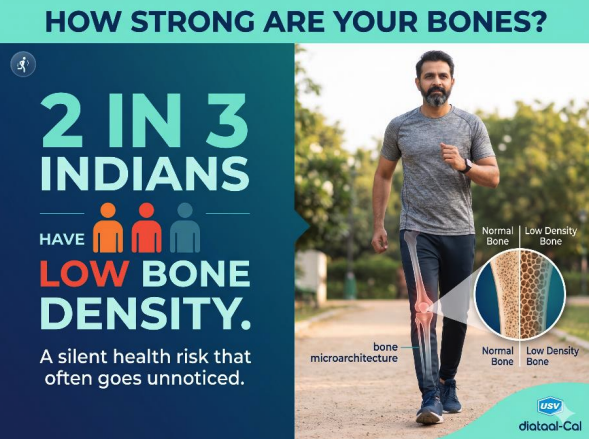
Because bone loss is completely painless in its early stages, our skeletons deteriorate silently. Most people only discover their bones have thinned after they cross age 50, or when a simple, everyday trip or fall results in an unexpected fracture. Peak bone mass is reached
by age 30 and gradually declines every year after. Your bones are the structural foundation of every movement you make—from walking and bending to carrying your family—and discovering your risk profile today gives you the power to protect your mobility before an
injury occurs.
Decoding Your Assessment: What Your Habits Say About Your Bones
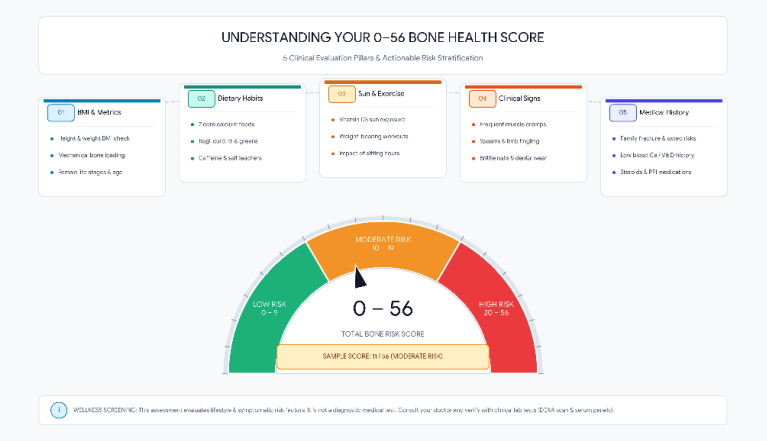
Your questionnaire evaluated five critical pillars: your BMI and life stage, your calcium intake, your sunlight and activity levels, subtle symptoms (like cramps or brittle nails), and your medical history.
YOUR RISK STRATIFICATION AT A GLANCE:
- Low Risk (0–9 Points): Your daily bone-care habits are currently on track.
- Moderate Risk (10–19 Points): You have emerging risk factors—such as missing daily calcium foods, sitting for long hours, or a Vitamin D deficiency.
- High Risk (20–56 Points): Your lifestyle habits, symptoms, or medical history put your bones at higher risk, requiring prompt attention.
Knowing your risk is half the battle; fixing it requires a supplement your body can actually use.
The Problem with Average Calcium Supplements: Big Pills, Upset Stomachs
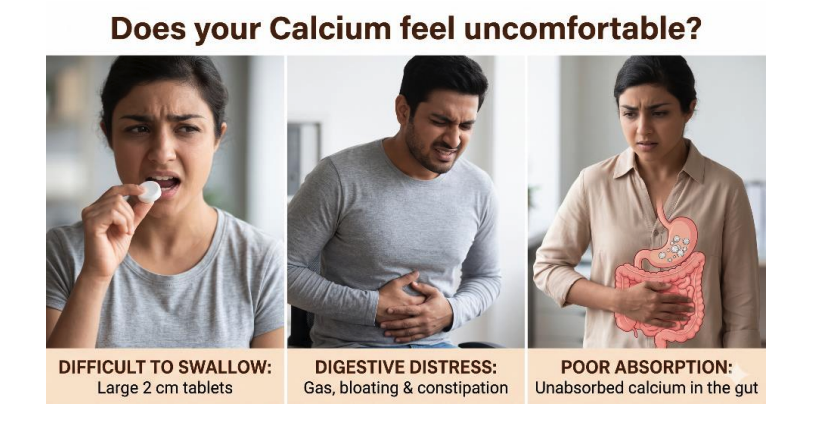
When faced with low bone density, most people grab generic over-the-counter calcium pills. Unfortunately, traditional supplements create friction that causes many people to stop taking them:
Difficult to Swallow: Standard calcium pills are bulky, chalky tablets measuring up to 2 cm, making them uncomfortable to swallow.
Digestive Distress: Conventional formulations rely on rock-derived calcium carbonate that reacts violently with stomach acid, causing uncomfortable bloating, acid heaviness, and severe constipation.
Low Absorption & Deposition Risks: Traditional calcium carbonate achieves only about 30% absorption, while citrate malate delivers roughly 40%. Because the body cannot readily absorb these large molecular compounds, unabsorbed calcium lingers in the gut and can deposit in soft tissues, raising concerns regarding kidney stones and arterial calcification.
The Diataal-Cal Advantage: Powered by Japanese Patented Technology
To eliminate the common side effects of calcium therapy, USV—the pharmaceutical leader behind household therapies like Glycomet and Ecosprin—developed Diataal-Cal.
Diataal-Cal uses Active Absorbable Algal (AAA) Calcium, sourced from pristine marine algae—the World’s Richest Natural Source.
Patented Japanese Technology: Processed using Japanese Patented technology, the algal minerals are refined into ultra-fine micro-particles that dissolve smoothly without requiring excessive stomach acid.
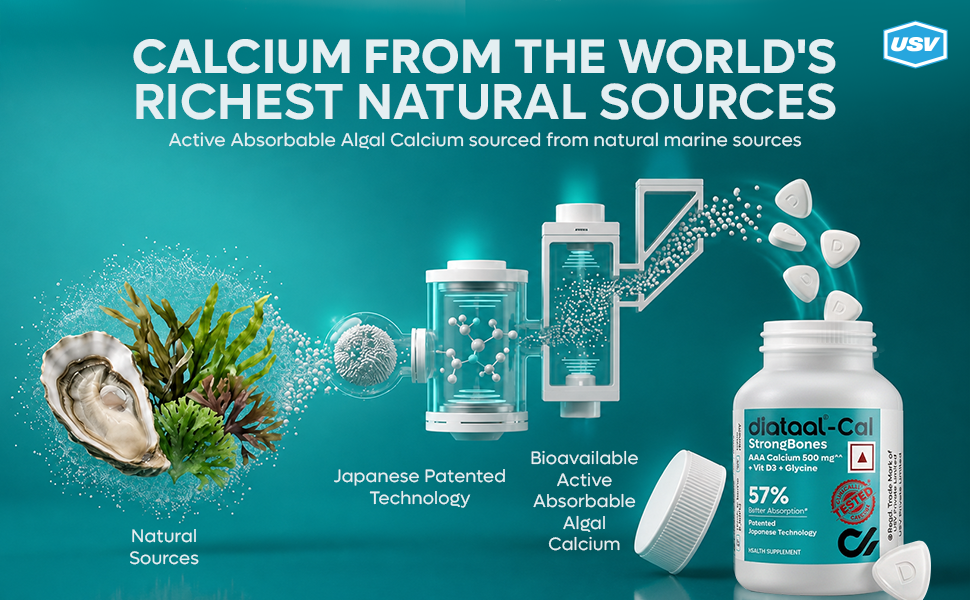
57% Higher Absorption: Clinical studies prove that AAA Calcium delivers 57% better absorption than standard calcium carbonate, achieving up to 95% bioavailability
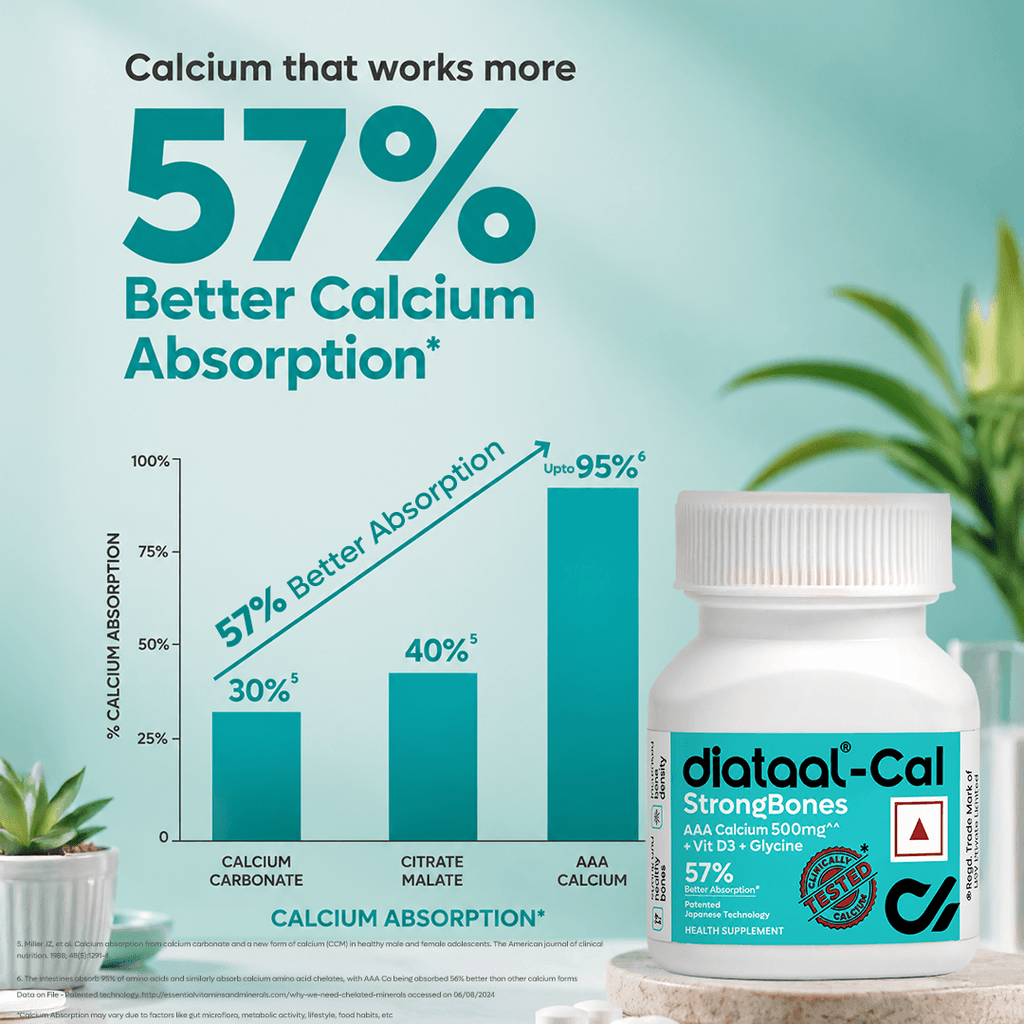
through natural intestinal pathways.
Half the Size, Gentle on the Stomach, Complete Bone Care
Diataal-Cal re-engineers the daily calcium experience to ensure you stay consistent:
Up to 1 cm Size: At nearly half the size of conventional 2 cm pills, Diataal-Cal tablets are compact, smooth, and easy to swallow.
No Bloating or Constipation: Clinically tested to be gut-friendly, it digests comfortably without generating gas or causing digestive heaviness.
The Power Trio Formula: Each tablet combines 500 mg AAA Calcium with 400 IU Vitamin D3 (for active intestinal absorption) and Glycine (the crucial amino acid that builds the flexible collagen framework of resilient bones and joints).
Important Advisory
1. Screening Tool Only: The Bone Health Check is an educational risk assessment designed for wellness awareness; it is not 100%
accurate and cannot diagnose, treat, or prevent any medical condition.
2. Not a Doctor’s Diagnosis: Results are based solely on self-reported inputs and cannot substitute for professional medical
advice, clinical evaluations, or doctor consultations.
3. Confirm with Clinical Testing: To determine your definitive bone mineral density, consult a qualified physician and undergo
diagnostic evaluations (such as a DEXA scan or serum blood tests) at an authorized laboratory.
References
- Babhulkar, S., et al. (2021). Prevalence of osteoporosis in India: an observation of 31,238 adults. International Journal of
Research in Orthopaedics, 7(2):362–368. - The Journal of the Association of Physicians of India. (2004). New Japanese technology for osteoporosis and calcium paradox
disease, 52:564–567. - Uenishi, K., et al. (2010). Fractional absorption of active absorbable algal calcium (AAA-Ca) and calcium carbonate measured by
a dual stable-isotope method. Nutrients, 2(7):752–761. - Miller, J. Z., et al. (1988). Calcium absorption from calcium carbonate and a new form of calcium (CCM) in healthy male and
female adolescents. The American Journal of Clinical Nutrition, 48(5):1291–1294. - Zhu, K., & Prince, R. L. (2012). Calcium and bone. Clinical Biochemistry, 45(12):936–942.
- Bolland, M. J., et al. (2015). Calcium intake and risk of fracture: systematic review. BMJ, 351, h4580.
- National Institutes of Health (NIH). (2011). Calcium: Fact Sheet for Health Professionals. Office of Dietary Supplements.
- The intestines absorb 95% of arnino acids and similarly absorb calcium an-lino acid chelates, with AAA Ca being absorbed 56%
better than other calci- um forms- Data on File. Patented Japanese Technology: Intestinal Absorption of Amino Acid Chelated
AAA-Calcium Matrices. - New Japanese technology for osteoporosis and calcium paradox disease. The Journal of the Association of Physicians of India.
2004 Jul 1,-52:564-7 - For More Information related to ingredients refer diataal Cal Nutritional Panel
- Calcium Absorption may vary due to factors like gut microflora, metabolic activity, lifestyle, food habits, etc
Related posts
You Just Checked Your Bone Health Score: Here Is What Your Result Really Means (And What to Do Next)

Stay Healthy This Festive Season with a Boost from Diataal

Leave a Reply